Retail investors are often described as though they are naturally unstable, overly emotional, or incapable of becoming long-term supporters of a public company. That view is not only lazy. It causes issuers to miss one of the most important opportunities available to them in the public market.
Retail is not the problem. Uninstrumented retail is the problem.
In the small-cap market especially, retail investors can become an important source of stability. They often engage earlier than institutions. They can be highly responsive when a story is presented clearly. And over time, they can become repeat participants with real conviction. But that only happens when management gives them a framework for understanding what matters, how progress should be interpreted, and why the company deserves ongoing attention beyond the next headline.
Without that structure, retail participation becomes reactive. Investors chase announcements, respond to momentum, and disappear when uncertainty returns. The issue is not intelligence. The issue is that the company has done too little to build clarity, cadence, and community around the shareholder experience.
One consumer technology issuer sought out Issuer Exchange after recurring bursts of retail attention failed to turn into durable shareholder support. The company could generate attention. Product news and digital activity were drawing retail eyes to the stock, and management had reason to believe the story resonated. But the trading pattern remained fragile. Retail interest appeared in bursts, often around announcements or social activity, then faded quickly. The stock showed signs of awareness, but not loyalty. Each new update seemed to reacquire attention instead of building on the last one.
Management initially viewed this as the unavoidable nature of retail. But the deeper issue was that the company had not yet built enough structure around investor engagement. Retail holders were being asked to interpret the story in fragments. Important milestones lacked enough plain-language context. Updates were visible, but not always connected into a consistent narrative that could help investors understand progress between quarters. There was attention, but not enough reinforcement to turn that attention into retained conviction.
After Issuer Exchange was brought in, the company and its vendors began to reframe retail participation as something measurable and developable. Communication became more focused on clarity. The company worked to provide more coherent context around what mattered and why. Cadence improved so investors were not encountering the story only in episodic bursts. Repeat engagement became more intentional, with the goal of helping investors stay connected to the company’s progression rather than rediscover it from scratch each time.
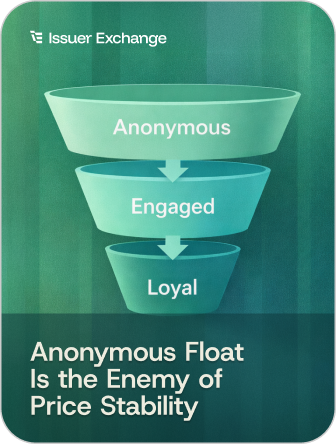
This did not turn retail into a monolith. It did something more useful. It allowed management to start distinguishing between passive awareness and active, repeat-engaged behavior. Over time, the company became less focused on generating momentary excitement and more focused on reducing churn.
So What Happened
As communication discipline improved, retail participation became less episodic and more durable. The company began to see evidence that investors were returning across reporting cycles rather than simply reacting to isolated news items. The stock still experienced volatility, but the shareholder base became more understandable and more resilient.
Retail Investor Engagement
+34 pts
Retail investor engagement increased from 29% to 63% after the company began explaining its business model, milestones, and market opportunity in clearer, more accessible language.
Educational Content Completion
+37 pts
Educational content completion improved from 26% to 63% as retail investors were given better tools to understand what the company did, why it mattered, and what progress to watch for.
Retail Watchlist Conversion
+22 pts
Retail watchlist conversion increased from 18% to 40%, showing that more retail investors moved from casual awareness to ongoing interest in the company’s story.
This is where many issuers go wrong. They think loyalty is hype. It is not. Loyalty is reduced churn. It is what happens when investors have enough clarity, enough cadence, and enough ongoing connection to remain engaged instead of resetting their view every time the stock becomes noisy.
The lesson is simple: retail is not dumb money. It is money that is too often left without a system. Every quarter, issuers have another opportunity to convert passive attention into repeat engagement and stronger hands. Issuer Exchange helps companies build that engagement more deliberately so retail participation becomes a source of resilience rather than fragility. Learn how Issuer Exchange can help you turn investor attention into stronger long-term support.
Last Updated: 7 Jan, 2026