Most issuers can tell you their share count. Far fewer can tell you much about the quality of the shareholder base behind it. That distinction matters because a public company does not trade on share count alone. It trades on the behavior, durability, and conviction of the hands holding the float.
When most holders are effectively invisible, the market becomes harder to interpret. Management may know how many shares are outstanding, but not whether participation is being driven by short-term event traders, disengaged retail holders, repeat investors building conviction, or fast-moving churn that disappears as quickly as it arrived. In practical terms, the float becomes anonymous. And anonymous float is rarely stable.
That instability is one of the hidden costs of being public. Volume may look healthy around catalysts, but if the underlying participants are mostly weak hands, the support rarely lasts. News generates attention, then fade. New buyers appear, but they do not become repeat holders. The stock remains vulnerable to churn because the company has too little visibility into whether its shareholder base is strengthening or simply recycling.
A consumer-focused public company turned to Issuer Exchange after it became clear that bursts of shareholder activity were not translating into a more stable base. The stock showed periodic waves of retail interest, particularly around product updates and commercial announcements. Management took some comfort in the activity, assuming the business was gradually building awareness in the market. But the trading pattern told a more fragile story. The stock struggled to hold support between updates. Volume came in around events, but there was little sign that participation was compounding into a more durable base. Each quarter felt like a reset.
The issue was not that the company had no audience. The issue was that management had very little insight into which parts of that audience were actually becoming loyal participants. Too much of the float was effectively anonymous in behavioral terms. The business could see traffic, but not traction. Without a better map of engagement, the company was left guessing whether it was building stronger holders or simply attracting short-duration attention.
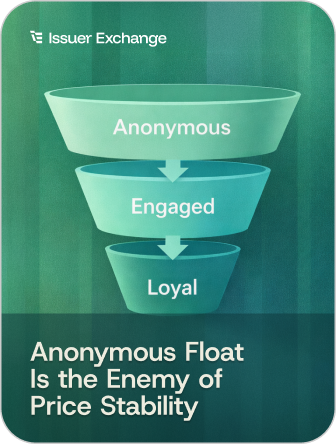
After Issuer Exchange was brought in, the company and its vendors began to shift away from viewing the float as a single undifferentiated mass. Instead, management started looking at participation through a progression: anonymous awareness, engaged interest, repeat engagement, and emerging loyalty. The goal was not to identify shareholders personally. It was to understand how behavior changed over time and whether the stock was beginning to retain conviction rather than merely attract momentary activity.
That led to changes in communication and follow-through. Updates were framed less as isolated bursts of news and more as part of a continuing operating narrative. Management paid closer attention to which forms of engagement actually deepened participation and which simply drove temporary volume. Over time, the company stopped judging market quality by attention alone and began judging it by retention.
So What Happened
As the company became more intentional about moving holders from passive interest to repeat engagement, the trading profile began to improve. Catalysts were less likely to function as one-day events. Shareholder behavior became easier to interpret from quarter to quarter. Most importantly, management had a clearer sense of whether the base was becoming more resilient or more fragile.
Known Shareholder Coverage
+29 pts
Known shareholder coverage increased from 18% to 47% as the company improved its ability to identify, segment, and communicate with investors already active in the stock.
Repeat Investor Engagement
+26 pts
Repeat investor engagement improved from 31% to 57% after the company shifted from broad, anonymous outreach to more targeted communication with known and interested shareholders.
Post-Catalyst Shareholder Retention
+18 pts
Post-catalyst shareholder retention increased from 46% to 64%, reducing the number of investors who exited immediately after major announcements.
This is where many issuers go wrong. They assume awareness is enough. It is not. A stock can attract attention and still be structurally fragile if the float is dominated by invisible, weak-duration participation. When management cannot tell whether the base is strengthening, it cannot build real price stability.
The lesson is simple: anonymous float is the enemy of price stability. The market rewards companies that strengthen the quality, not just the size, of their shareholder base. Issuer Exchange helps companies turn unknown participation into a more usable loyalty map so each quarter can build on the last instead of resetting from scratch. Learn how Issuer Exchange can help you build a stronger and more resilient shareholder base.
Last Updated: 7 Jan, 2026