Public companies spend enormous energy measuring the business. Revenue, burn, margins, milestones, pipeline, hiring, and product development all receive attention. But once a company is public, there is another operating system running alongside the business itself: the market. And many management teams still fail to measure it with enough discipline.
That creates a dangerous blind spot. A stock is not just a scoreboard that tells management whether investors approve or disapprove. It is a behavioral system. It reflects how participants are reacting to information, uncertainty, liquidity conditions, and one another in real time. Price is only the most visible layer. Beneath it sit a range of signals that tell a deeper story about how the company is actually being interpreted.
Why did volume surge on a quiet day? Why did spreads widen after an announcement management believed was positive? Why did off-exchange trading increase while visible price quality weakened? Why did volatility expand even though the company thought it had reduced uncertainty? These questions matter because if management cannot explain them, someone else will. And in public markets, the first explanation often becomes the narrative.
One newly public software infrastructure company came to Issuer Exchange after the tape had already started sending signals management could not clearly explain. From management’s perspective, the business was progressing. Product development was on track. Customer discussions were moving forward. The company had issued several updates that, internally, felt constructive and appropriately timed. But the stock was behaving in ways the team could not fully explain. Volume would spike unexpectedly. Spreads would widen after seemingly good news. The company would see activity around updates, but little evidence that the participation was building into a stronger base.
Management initially assumed this was just noise. Like many newly public teams, they believed that if the fundamentals continued improving, the stock would eventually reflect it. But the problem was not just price. It was interpretation. The market was reacting to signals that management was not measuring closely enough, which meant others were left to define what those signals meant.
After engaging Issuer Exchange, the company and its vendors began to approach the tape as an information source rather than an emotional distraction. Instead of asking only whether the price had moved, management started asking why. Trading patterns were reviewed more systematically. Volume surges, spread changes, venue mix, and post-event behavior were analyzed in the context of company updates. The goal was not to overreact to every fluctuation. It was to identify whether the market was absorbing information constructively or whether fragility was building beneath the surface.
That changed how the company communicated. Updates became more tightly framed. Milestones were connected more clearly to investor-understandable outcomes. Management became more attentive to which announcements produced durable participation and which created only temporary activity. The tape stopped being something that happened to the company and became something management could learn from.
So What Happened
Over time, the company’s market interpretation became less reactive and more informed. Trading anomalies that had once been confusing were easier to contextualize. Management had a better sense of which signals actually mattered and how the market was receiving its communications. The stock did not become noise-free, but the company became far less exposed to narrative drift caused by its own lack of visibility.
Post-News Trading Insight
+41 pts
Post-news trading visibility increased from 37% to 78% as the company began tracking how investors responded after each announcement, rather than relying only on closing price and volume.
Unexplained Volume Events
-35%
Unexplained volume events decreased by 35% after management began monitoring trading patterns, shareholder movement, and investor engagement around key catalysts.
Catalyst Performance Reviews
+67 pts
Structured post-catalyst reviews increased from 25% to 92%, giving the company a clearer understanding of which announcements created durable investor interest and which required stronger follow-up.
This is where many issuers go wrong. They think the market is just something to watch, not something to measure. But public markets are always assigning meaning. If management does not understand why the tape is behaving the way it is, someone else will supply that explanation, and the company may find itself reacting to a narrative it never intended to create.
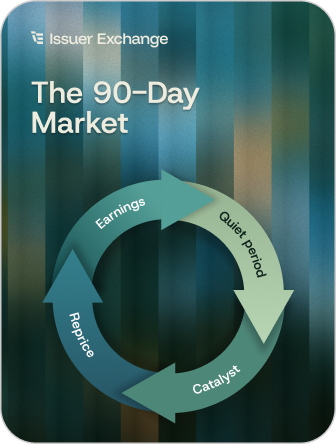
The lesson is simple: if you do not measure the tape, the tape will measure you. Every quarter, the market translates behavior into narrative, and narrative into price. Issuer Exchange helps companies turn that behavior into usable intelligence so they can identify emerging risks earlier, interpret the tape more clearly, and strengthen control over the next 90-day cycle. Learn how Issuer Exchange can help you turn market behavior into better decision-making.
Last Updated: 7 Jan, 2026