Capital raises are often framed as moments of necessity. A company needs money, goes to market, and accepts the terms available. But that view misses something important. Financings are not just capital events. They are information events. They reveal how well the market understands the story, how much confidence exists in the stock, and how much leverage management actually has when it enters negotiations.
Without strong market intelligence, financings often happen from a position of weakness. Management knows the runway. It knows the business plan. It knows the capital requirement. But the market is underwriting something broader. It is pricing liquidity quality, shareholder durability, recent tape behavior, event absorption, and the degree to which the story appears stable rather than fragile. If management cannot see those conditions clearly, it usually negotiates from need rather than leverage.
By the time one public resource company engaged Issuer Exchange, management was already confronting the risk of entering a capital decision without enough visibility into the tape. The company had legitimate strategic reasons to consider raising capital. It had development milestones ahead, needed flexibility, and believed its long-term opportunity justified additional support. But the stock was trading in a way that made timing the financing difficult. Activity around updates had been inconsistent. Some volume looked encouraging, but management could not tell whether shares were being absorbed constructively or simply churned through short-term hands. The risk was not just dilution. It was entering negotiations without a clear sense of how the market would price the raise.
Internally, the temptation was to focus only on the business need and move quickly. But once Issuer Exchange became involved, the company and its vendors began treating the financing decision as part of a broader market-readiness exercise. Instead of asking only how much capital was required, management also examined liquidity windows, the strength of post-catalyst participation, and whether recent trading behavior suggested support or fragility. The company paid closer attention to when the market seemed to absorb stock more constructively and which updates actually strengthened the narrative rather than merely generating activity.
That changed the company’s posture. It did not eliminate the need to raise capital, nor did it make the market easy. But it allowed management to approach negotiations with more context. The company had a better sense of when timing might improve terms, how its recent trading behavior would be interpreted by outside capital, and which narrative elements were actually helping reduce perceived risk. The financing discussion became less desperate and more structured.
So What Happened
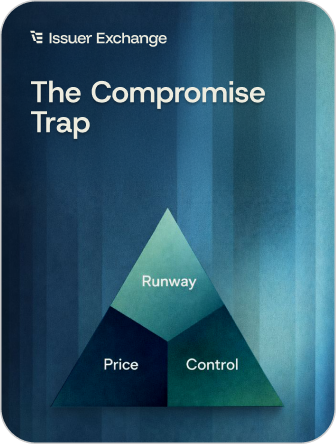
Over time, the company was able to approach its capital planning with more discipline. Management had a better understanding of when the tape supported constructive engagement and when fragility was likely to worsen terms. The financing process was still a compromise, but it was approached with more leverage, better timing, and clearer narrative control than it otherwise would have been.
Capital Conversation Efficiency
+36%
Capital conversation efficiency improved by 36% as management used investor engagement data to prioritize higher-quality conversations and reduce time spent with poor-fit capital sources.
Investor Targeting Accuracy
+31 pts
Investor targeting accuracy increased from 42% to 73% after the company used shareholder behaviour, engagement history, and investor profile data to focus on better-aligned investors.
Financing Friction
-24%
Financing friction decreased by 24% as the company entered discussions with stronger evidence of investor interest, clearer positioning, and a better understanding of market demand.
This is where many issuers go wrong. They assume capital is raised on fundamentals alone. But public markets price confidence in the path, not just confidence in the asset. If management does not understand how the tape is behaving, it often accepts worse terms than necessary simply because it entered the conversation blind.
The lesson is simple: data turns negotiations into leverage. Every quarter, the market reveals whether an issuer is approaching the next capital decision from strength, fragility, or guesswork. Issuer Exchange helps companies replace guesswork with clearer intelligence so financing decisions can be made with more control over timing, structure, and narrative. Learn how Issuer Exchange can help you negotiate capital from a more informed position.
Last Updated: 7 Jan, 2026