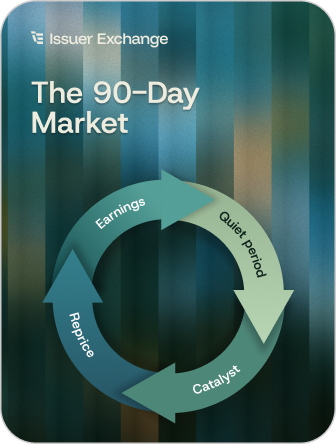
Capital markets do not invest in a company’s story in any permanent sense. They rent it, usually for about 90 days at a time, and reprice it with every new data point. Earnings, guidance, financings, product milestones, customer announcements, and shifts in trading behavior all feed an ongoing cycle of reassessment. For public companies, that cycle is not background noise. It is the environment they operate in.
Too many management teams still behave as though the market will patiently wait for a long-term strategy to reveal itself. It usually will not. Public markets demand periodic confirmation. Every quarter, investors revisit the same core question: is the company becoming more credible, or less? If management does not answer that question clearly and consistently, the market answers it on its own, often through price weakness, wider spreads, lower-quality liquidity, or fading attention.
That is why the quarterly cycle matters so much. It is not just a reporting obligation. It is a feedback loop. Each 90-day window gives the market a chance to compare expectations with evidence. The story is not judged once. It is judged repeatedly. A company that understands this can shape perception over time. A company that ignores it is left reacting to a narrative it no longer controls.
In one Issuer Exchange engagement, a newly public aerospace systems company specializing in advanced drone and sensor technology was grappling with a familiar public-market challenge. The business had real strengths: credible leadership, differentiated products, active commercial discussions, and meaningful interest from industry counterparties. Internally, management was focused on execution and believed the market would recognize progress as contracts matured. But the trading pattern told a different story.
The company would experience brief bursts of attention around announcements, followed by drift. Volume came in around news, but it did not convert into durable support. New investors appeared to engage with the headline, then disappear before the next reporting cycle. Existing holders were not being given enough structured context and narrative to understand what milestones mattered, what timelines were realistic, and how to interpret progress between quarters. The issue was not necessarily that the business was underperforming. The issue was that the market was left to fill in too many blanks.
Working through Issuer Exchange, the company and its vendors established discipline and began to treat the quarter as a system rather than a sequence of isolated events. Instead of viewing earnings, updates, and market communication as separate exercises, management started aligning them into a more intentional cadence. The goal was simple: reduce uncertainty at each stage of the cycle.
That meant tightening the relationship between what the company said and what the market could reasonably track. It meant improving how milestones were framed, making clear which developments were commercially important and which were simply incremental. It also meant paying closer attention to how the stock behaved after each event. Did the update bring in sustained participation or just temporary activity? Did the market understand the significance of the announcement, or was it treated as another generic headline? Did the shareholder base appear to strengthen or churn?
Those questions matter because the market does not reward activity for its own sake. It rewards evidence that lowers uncertainty. A catalyst only helps if it makes the company easier to understand and easier to underwrite. When communication is vague, even good progress can be discounted. When communication is disciplined, the same progress can build trust.
So What Happened
Over time, the company’s approach became less reactive. Instead of waiting for the next quarter and hoping the market would connect the dots, management used each quarter to reinforce a coherent operating narrative. Company updates became part of a progression. The market had clearer markers to judge. The shareholder base had more reason to stay engaged. Confidence did not improve because the company suddenly changed its business. Confidence improved because the company learned how to operate inside the rhythm of the public market.
Quarterly Investor Re-Engagement
+33%
Quarterly Investor Re-Engagement Increased from 31% to 64% as investors were given a clearer sequence of updates, milestones, and reasons to stay involved between news cycles.
Post-Catalyst Retention
+37%
Retention improved from 42% to 69%, reducing the number of short-term holders who exited immediately after announcements.
Narrative Continuity Score
+58%
Narrative continuity improved by 58% as each quarterly communication connected directly back to the company’s larger strategic roadmap.
This is where many issuers go wrong. They assume that if the business is improving, the stock will eventually reflect it. Sometimes that happens. Often it does not happen on management’s preferred timeline, and not without unnecessary volatility along the way. Public markets are not designed to reward patience in the abstract. They reward companies that repeatedly earn belief.
The lesson is simple: if you are not operating on a quarterly feedback loop, you are operating on hope. Hope is not a strategy for a public company. The market is constantly repricing trust, and trust is built through repeated confirmation. Every 90 days, management has an opportunity to narrow the gap between story and evidence. Companies that understand that dynamic can build stronger holders, more resilient trading behavior, and better positioning for future capital decisions.
The 90-day market is not going away. Every quarter, the market re-evaluates your company, your credibility, and your ability to convert progress into confidence. Issuer Exchange helps companies navigate that cycle with greater clarity, stronger shareholder engagement, and a more disciplined market strategy. Learn how Issuer Exchange can help you build a more resilient shareholder base and turn each quarter into an advantage.
Last Updated: 7 Jan, 2026