Most issuers still approach public markets in fragments. A press release here. An earnings call there. A financing update, a conference appearance, a burst of outreach, and then relative silence until the next visible event. The problem is that the market does not experience a company in isolated moments. It experiences a company as a continuous system.
That is why the companies that navigate public markets most effectively do not simply “do IR.” They run a shareholder operating system.
A shareholder operating system is more than a communication calendar. It starts with measurement. Trade behavior, liquidity conditions, event response, shareholder engagement, and early signals of regime shifts all have to be monitored consistently rather than episodically. Public markets are constantly revealing whether confidence is building or fading, and companies that fail to watch those signals usually find themselves reacting too late.
But measurement alone is not enough. A real operating system also needs playbooks. The most effective issuers think about the market before, during, and after each meaningful event. What expectations are already in the stock? How should the message be framed so it reduces uncertainty instead of adding to it? What should management watch afterward to determine whether the market actually absorbed the update constructively? This kind of discipline is what separates reactive IR from repeatable public-company execution.
A recently public enterprise services company came to Issuer Exchange after management had already begun to feel the cost of approaching the market in disconnected pieces. Management was active and hardworking. Updates were being issued. Investors were being contacted. The company was participating in public-market routines in a way that looked reasonable from the outside. But internally, the process felt fragmented. Different communications were not always reinforcing one another. There was limited visibility into how the stock behaved between events. Each quarter felt like a fresh attempt to rebuild market understanding rather than a continuation of a coherent strategy.
The issue was not a lack of effort. It was a lack of operating architecture around the shareholder base.
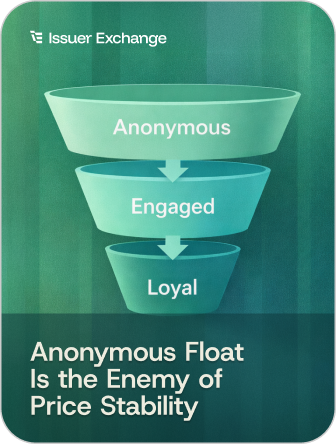
After engaging Issuer Exchange, the company and its vendors began turning those episodic efforts into a more integrated system. Instead of treating press releases, investor updates, and trading behavior as separate categories, management began viewing them as connected parts of the same public-market process. Trade behavior was monitored more consistently. Event planning became more structured. Post-event analysis became part of the operating rhythm. The company also focused more deliberately on moving investors from awareness to repeat engagement rather than simply generating one-off interest.
That shift changed how management related to the market. Instead of waiting for the next quarter and hoping the story would connect, the company began building a more continuous feedback loop. The stock’s behavior became less mysterious. Communications became less improvised. The company was not just “doing IR” anymore. It was beginning to run a system.
So What Happened
Over time, the company developed more consistency in how it approached the market. Shareholder engagement became less episodic. Management had earlier visibility into shifting conditions. Event communication became part of an ongoing framework instead of a set of disconnected tasks. The result was not perfection, but greater repeatability and much stronger control over how the quarter unfolded.
Investor Touchpoint Consistency
+52 pts
Investor touchpoint consistency increased from 28% to 80% after the company moved from irregular outreach to a structured monthly engagement process across priority investor segments.
Tracked Investor Activity
+61 pts
Tracked investor activity improved from 19% to 80% as the company began capturing meetings, follow-ups, inbound questions, shareholder signals, and engagement history in one operating system.
Repeat Engagement Rate
+27 pts
Repeat engagement increased from 30% to 57% after the company stopped treating investor relations as a campaign and started managing it as a continuous shareholder development function.
This is where many issuers go wrong. They think public-market success comes from occasional good communication. But the market rewards operating systems, not isolated moments. Companies that fail to build a repeatable framework end up relearning the same lessons quarter after quarter.
The lesson is simple: winners do not just “do IR.” They run a shareholder operating system. Every quarter, the market asks whether management is measuring behavior, learning from feedback, and building a stronger base for the next cycle. Issuer Exchange helps companies answer yes with greater discipline, clearer insight, and more repeatable execution. Learn how Issuer Exchange can help you build a more resilient system around your shareholder base.
Last Updated: 7 Jan, 2026